Cart
new
Cyma forma ALT
- Read reviews (0)
- Related accessories
-80 €
with code BLACKNOVEMBER26-80
Copier
- Free delivery
- Low prices guaranteed
- Satisfied or refunded
- 3-years warranty
Pre-order
contact us
Stock in store
Not available in store
INFORM ME OF ITS ENTRY IN STOCK
I want to be notified by email
Go
Payez 115.14 € / mois par carte bancaire
- en 3x4x10x12x
- TAEG fixe 16.9 %
- Simuler
-
Apport initial:106.58 €
-
Mensualités:11 x 115.14 €
-
Montant financement:1172.42 €
-
Coût financement:94.12 €
-
Montant total dù:1266.54 €
ATTENTION ! UN CRÉDIT COÛTE DE L'ARGENT ET DOIT ÊTRE REMBOURSÉ.
The brand Cyma forma
Learn more about the brand and discover the entire catalog.
The largest network of stores in France
Find all the information on our superstores and our specialized boutiques.
Contact an expert
Our musician and enthusiast tele-consultants are here to answer all your questions.
Synthesizer
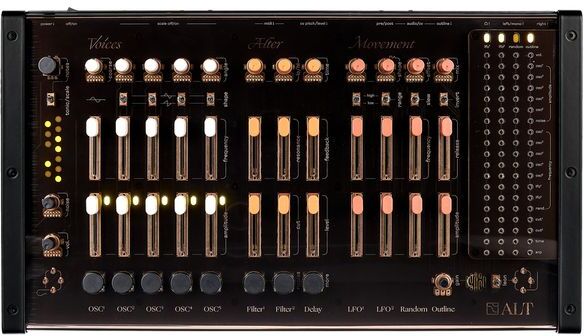
The CYMA FORMA ALT is an analog synthesizer manufactured in Paris, designed to create drones, evolving soundscapes, and generative compositions. With its five oscillators, pin-based modulation matrix, and environmental sensors, it is aimed at electronic musicians, experimental artists, and sound design enthusiasts. Its screenless interface encourages spontaneous creation, both in the studio and during live performances.
Key Features
- 5 independent oscillators: one sine-wave VCO and four DCOs with triangle or sawtooth waves for building complex textures and harmonies.
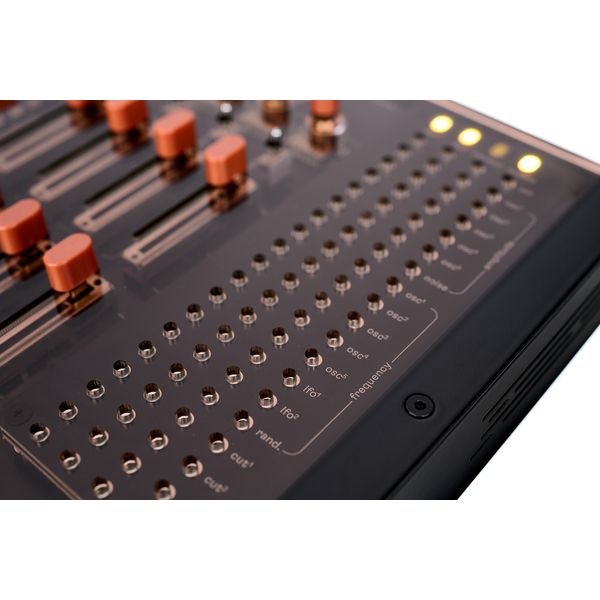
- 4 x 19-pin modulation matrix: Connect four modulation sources to 19 destinations to create sonic movements and generative sequences.
- Dual stereo analog filter: Shape frequencies with transitions between low-pass, band-pass, and high-pass filtering, all the way to self-oscillation.
- Harmonic quantizer with 15 customizable scales: explore different harmonic structures and microtonal tunings.
- Light sensors and built-in microphone: Use gestures, changes in light, and ambient sounds to modify sound parameters.
- MIDI and CV compatibility: integrate ALT into a sequencer, modular system, or music production environment.
Five oscillators for exploring sound design
The CYMA FORMA ALT is based on an architecture that combines a sine-wave analog VCO with four DCOs offering triangular or sawtooth waveforms. Each oscillator has its own tuning, allowing you to build chords, unusual intervals, or drones composed of multiple layers of sound.
Oscillators 2 through 5 also feature independent panning controls to distribute the different voices across the stereo field. A white noise generator rounds out this architecture to create noisier textures or enrich soundscapes. The harmonic quantizer, featuring 15 customizable scales, makes it easy to explore melodic and harmonic structures, including microtonal tunings.
Analog Filters and Stereo Delay
ALT features two analog stereo filters connected in series. Their operation allows you to gradually transition from low-pass to high-pass filtering, while also exploring band-pass behaviors. This allows you to attenuate certain frequencies, shape the spectrum of a drone, or emphasize specific areas of the sound.
The filters’ resonance can reach the point of self-oscillation, opening up additional possibilities for sound design. The stereo delay adds repeats and feedback effects to create sustained atmospheres or rhythmic patterns. This processing section can also accept external audio signals, allowing you to apply the filters and delay to other instruments or sound sources.
A modulation matrix dedicated to evolving sounds
At the heart of the CYMA FORMA ALT is a 4 x 19-pin modulation matrix. It allows you to connect four modulation sources to 19 destinations, without having to navigate menus or use computer programming. By changing the connections, you can modulate various parameters and create interactions between the synthesis elements.
Two LFOs, a Sample & Hold random generator, and an envelope follower allow you to produce cyclic variations, unpredictable changes, or modulations linked to a signal’s intensity. This combination is particularly well-suited for creating generative sequences, evolving drones, and soundscapes that gradually change without constant intervention.
Sensors for Interacting with Sound
The CYMA FORMA ALT features two light sensors and a microphone that transform its environment into a modulation source. Changes in lighting, hand movements, or captured sounds can thus influence the synthesizer’s behavior.
In particular, the light sensors allow you to control the pitch of the oscillators and the volume through gestures, using a principle similar to that of a theremin. The microphone opens up further possibilities for interaction with the voice, percussion, or ambient sounds. These controls offer an interesting gestural dimension for improvisation and experimental performances.
An Interface Designed for Experimentation
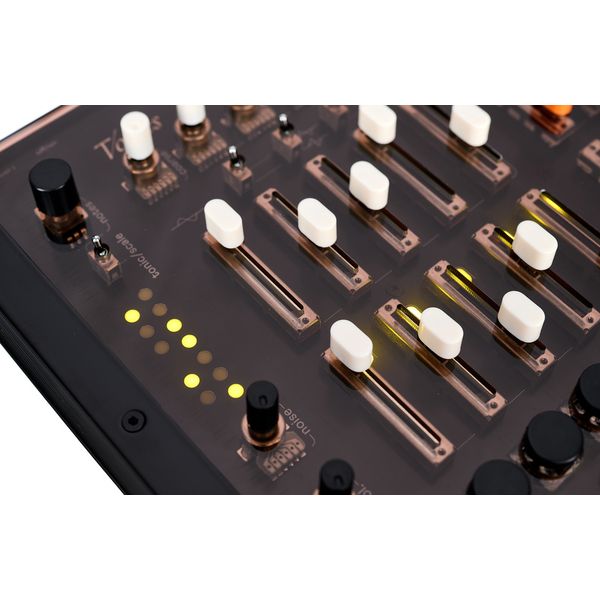
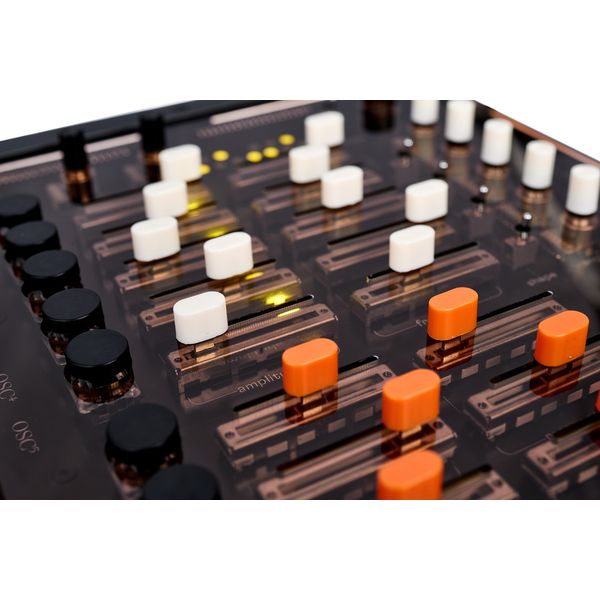
ALT prioritizes a direct approach to sound synthesis. With no screen or menu navigation, it provides access to its parameters via sliders, buttons, and its pin matrix. Adjustments are made directly on the instrument, allowing users to quickly experiment with different modulation configurations.
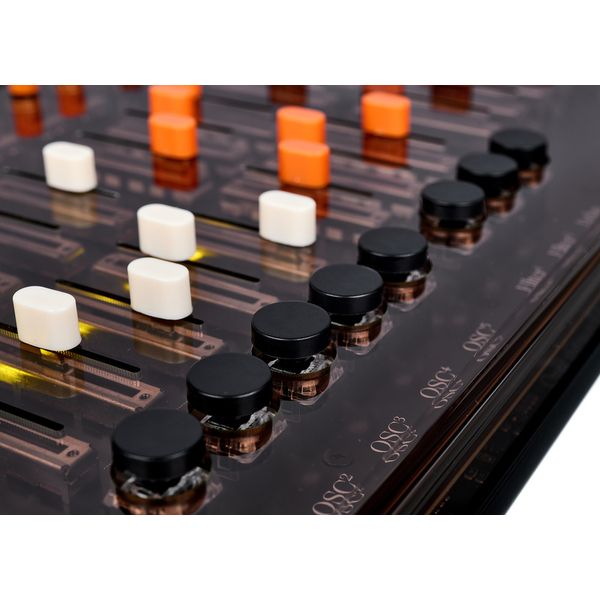
Its five mechanical keys allow you to manually trigger notes and interact with a composition. ALT can also operate in a generative manner, allowing modulation sources to evolve sequences and textures. It can thus be used for both improvisation and the creation of autonomous, ever-changing atmospheres.
MIDI and CV Connectivity
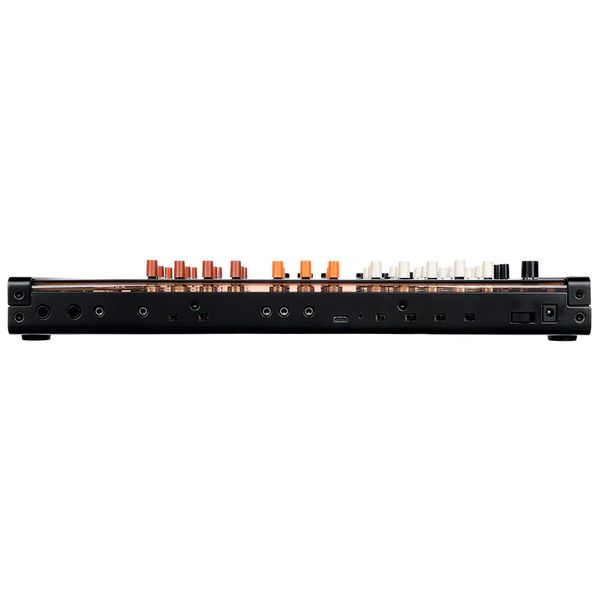
Thanks to its MIDI and CV compatibility, the CYMA FORMA ALT can be connected to sequencers, external controllers, and Eurorack modular systems. In particular, it receives MIDI messages for notes, velocity, aftertouch, and pitch bend, allowing you to incorporate various playing techniques and expressive controls into a performance.
Its various playing modes make it easy to use in a wide range of musical setups. It can be controlled by external equipment or serve as the centerpiece of a generative music setup, while its audio input allows you to use its sound processing section with other sound sources.
Lire la suite
Technical sheet
- Number of keys Less than 49 keys
- Touch Semi-light touch
- Type of synthesizer Analog
- General
- Type: generative analog synthesizer
- Sound engine: analog
- Polyphony: 5 voices via built-in controls, up to 4 voices in MIDI polyphonic mode
- Manufactured in Paris, France
- Chassis: glossy transparent Plexiglas and powder-coated steel
- Interface: sliders, buttons, and pin-based modulation matrix
- Dimensions: 404 x 227 x 57 mm
- Weight: 3.8 kg
- Sound generation
- 5 analog oscillators
- OSC 1: Sinusoidal VCO
- OSC 2–5: DCOs with triangular or sawtooth waveforms
- Built-in white noise generator
- Independent stereo panning control for OSC 2–5
- OSC 1 frequency range: 8 Hz to 8,372 Hz
- Frequency range for OSC 2–5: 16 Hz to 9,000 Hz with matrix modulation
- Harmonic quantizer: 15 customizable scales
- Support for microtonal tunings and just intonation
- Built-in 5-key mechanical keyboard
- Filters and Effects
- 2 Sallen-Key-type stereo analog filters connected in series
- Low-pass, band-pass, and high-pass filtering
- Resonance with self-oscillation
- Stereo delay with analog core and digital repeats
- Delay time: 30 ms to 1.5 s
- Adjustable feedback
- External audio signal processing
- Modulation
- Modulation matrix: 4 x 19 points
- Connections via 2 mm banana plugs
- 4 modulation sources
- 2 LFOs with transition between square and triangle waveforms
- LFO frequencies: 0.01 to 10 Hz in low-frequency mode, 0.7 to 1,190 Hz in high-frequency mode
- Sample & Hold random generator with slew function
- Random generator frequency: 0.1 to 30 Hz
- Outline envelope follower with amplitude, release, and inversion controls
- 19 modulation destinations
- Matrix-controlled arpeggiator
- 2 light sensors for pitch and volume modulation
- Built-in microphone for modulation based on ambient sounds
- Connectivity and MIDI
- MIDI input: 3.5 mm TRS mini-jack
- USB-C MIDI connection
- 4 MIDI modes
- MIDI reception: notes, velocity, aftertouch, pitch bend, and clock
- MIDI control of ADSR envelopes and portamento
- CV Pitch input: 3.5 mm mini-jack, ±5 V, 1 V/octave
- Master VCA Gate CV Input: 3.5 mm mini-jack, ±10 V
- Outline input: 3.5 mm mini-jack for audio or CV signal
- Left/Mono Audio Output: 6.35 mm jack
- Right audio output: 6.35 mm jack
- Headphone output: 3.5 mm stereo mini-jack
- Power
- External power supply included
- AC input: 110 to 220 V AC, 50/60 Hz
- Power output: 15 V DC, 2.5 A
- Power connector: 5.5 x 2.5 x 10 mm, center positive
More specifications
Fewer specifications
Often purchased with Synthesizer
-
X-TONE
X1005-3M Jack (M) 6,35 / Jack (M) 6,35
10.00 € -

AUDIO TECHNICA
ATH-M30 X
79.00 € -

X-TONE
X2002-6M - Jack(M) 6,35 mono / Jack(M) 6,35 mono S...
21.00 € -
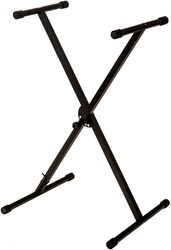
X-TONE
xh 6100 Self-Assembly Keyboard Stand
24.90 € -

PRODIPE
Pro 580
49.00 € -
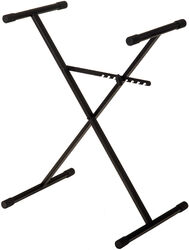
X-TONE
xh 6101 Keyboard Stand
27.90 € -

X-TONE
X2002-3M - Jack(M) 6,35 mono / Jack(M) 6,35 mono S...
19.30 € -
Gift ideas
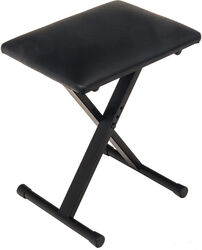
X-TONE
xb 6150 Black Foldable Bench
39.00 € -
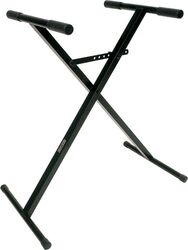
RTX
X103
46.95 € -
Gift ideas
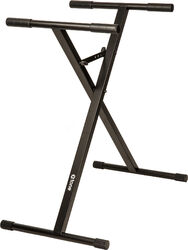
X-TONE
XH6102 Premium Keyboard Stand
44.90 € -
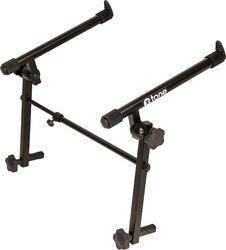
X-TONE
XH6110 Premium Keyboard Stand Extension
28.90 €